Mind The Sauna
The Journey From Reaction to Grace
I've spent thousands of hours in the sauna and cold baths. And I've watched what becomes possible when I shift how I relate to these practices.
In the beginning, the cold was unbearable. My entire nervous system was screaming escape. All the focus was on getting out. The thrashing, the desperate vocalizations, the sense that the pain was something I had to defeat or endure. The sauna was similar: reactive, fighting the heat, desperate to cool down, compelled to wipe the sweat, scratch the itch, mindlessly look around, do something to make the intensity stop.
This reactivity wasn't weakness. It was a completely natural nervous system response to threat. But something changed when I made a different choice.
I still drift back into default mode. I still feel the urge to escape, to fix, to grip. But here's what I discovered: when I decide to practice mindfully, when I actually choose to turn toward the sensation instead of away from it, everything shifts. The intensity doesn't get smaller. The cold is still cold. The heat is still hot. But in that moment of conscious choice, my relationship to the sensation transforms.
There's grace available in those moments. A certain ease, even in the most extreme conditions. When the urge to move arises in the sauna, I can notice it without being consumed by it. When the pain in the cold plunge builds, I can be present with it rather than identified with it. The key is that it only happens when I decide to practice.
It's not that I'm enduring better. It's that I'm relating differently. But I have to choose it.
The Pattern Everywhere
But here's what struck me: this same pattern shows up everywhere in my life.
There's tension in my rib cage and neck that doesn't seem to want to leave. My default response has been to fix it. Massage tools, hands, anything to generate more bloodflow, to get rid of it. There's an underlying belief embedded in this impulse: I have control. If I just work hard enough, apply the right technique, I can make it disappear.
I still fall into this pattern constantly. The desire to grip it, solve it, make it go away is powerful. But what I've realized is that this stance of "I must fix this" is actually creating more tension, not less. It's the same reactive relationship I had with the cold plunge. Just in a different form. And the moment I recognize that pattern and choose a different approach, something loosens.
Then I encountered an interview with Pema Chödrön, the mindfulness teacher. She was discussing her own back pain and her relationship with her physical therapist. What struck me was this: she actively engages in physical therapy. She follows medical advice. She doesn't ignore the pain or pretend it's not real. But her internal stance has shifted. Rather than clinging to the hope that the pain will eventually disappear entirely, she has accepted it as something she will likely live with for the rest of her life.
This isn't resignation. It's something much more interesting: she remains proactive in seeking treatment, but she's released the resistance to the pain's presence. She's not waiting for the pain to leave before she can relax.
That's the move. You can get the massage, see the therapist, do the work. And you can hold a completely different relationship to the sensation itself. That's the practice.
What's Actually Happening in Your Brain
For a long time, I understood this shift experientially. I felt the difference between reactivity and observation. But I wanted to know: what is actually happening in the brain when we make this move?
The answer is elegant, and it centers on a simple but revolutionary idea: there is no single "self" that experiences sensation. There are at least two.
Research by Norman Farb and colleagues at the Center for Mindfulness, published in Social Cognitive and Affective Neuroscience, identified what they call the "narrative self" and the "experiential self."
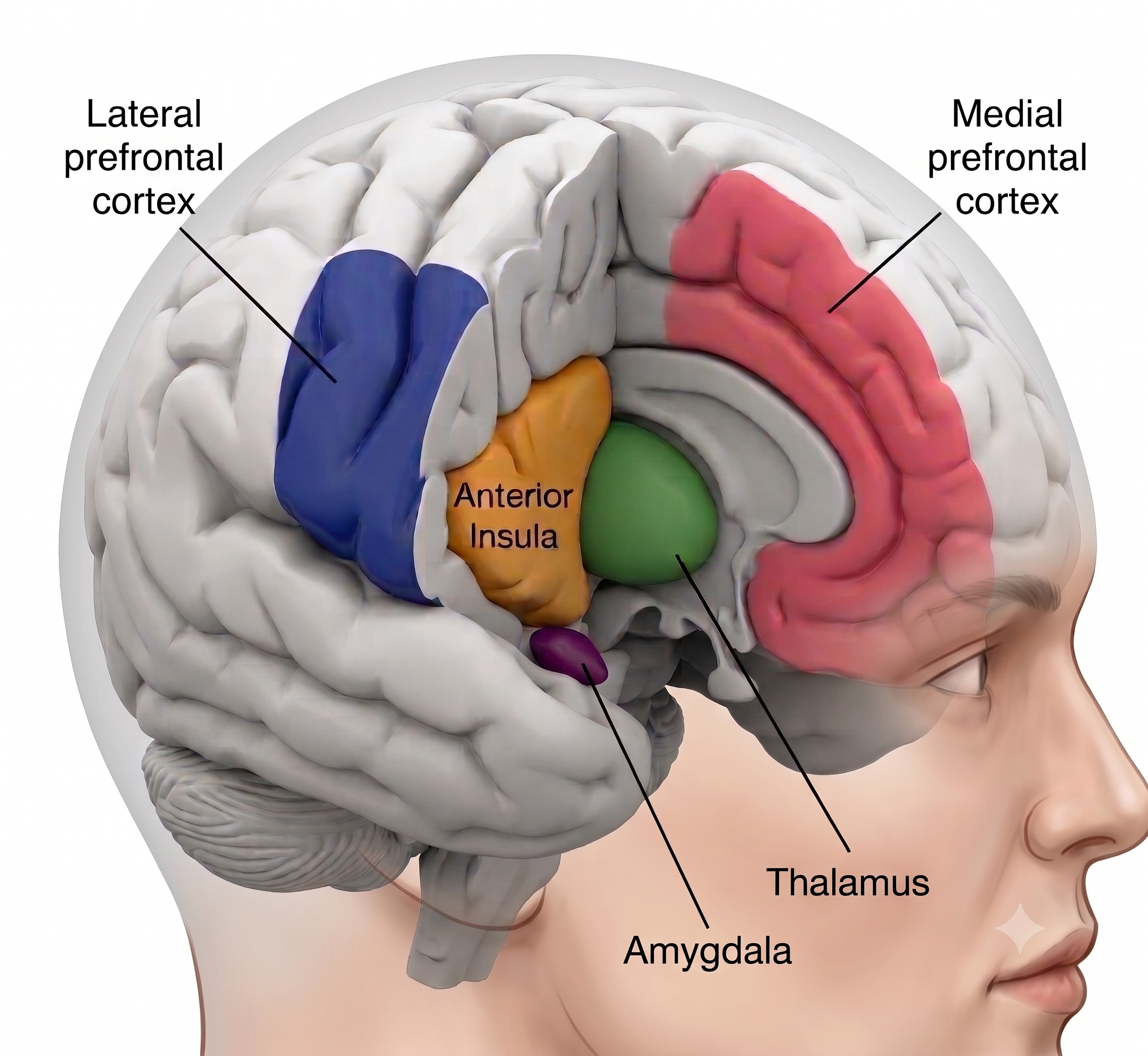
The narrative self is built by your brain's medial prefrontal regions. This is the part that constructs the ongoing story of "who you are." It's the voice that says, "I am someone who has back pain. I am someone who is anxious. I am someone who can't handle the cold." This self is useful for memory and planning, but it's also the seat of rumination and suffering. When you're identified with the narrative self, a sensation becomes a story: "This pain means I'm broken. This anxiety means I'm weak. This cold is unbearable."
The experiential self, by contrast, is built by lateral prefrontal regions and the anterior insula. Your body's sensing hub. This self simply notices: "There is sensation. There is temperature. There is intensity." No story. No ownership. No self-judgment.
When you turn your attention toward a sensation with mindfulness, you're not suppressing the narrative self. You're literally shifting the brain regions that are active. The research shows that after just 8 weeks of mindfulness practice, people show measurable changes in how these networks communicate. The narrative self quiets down. The experiential self lights up.
This is not theory. In Fadel Zeidan's landmark study at Wake Forest, participants received just four 20-minute training sessions in mindfulness meditation. Then they were exposed to painful heat. The results were stunning: mindfulness reduced pain intensity by 40% and pain unpleasantness by 57%. An effect Zeidan noted "produced a greater reduction in pain than even morphine or other pain relieving drugs, which typically reduce pain ratings by about 25 percent." How? Not by numbing the sensation, but by decoupling the thalamus (the brain's sensory relay) from the default mode network. The sensation still arrived. But it wasn't woven into the story of "self" anymore.
This is what grace looks like neurologically. Not dissociation, but a shift in which brain networks are in charge of interpreting what's happening.
Contrast Therapy as the Perfect Laboratory
This is why contrast therapy, the practice of moving between extreme temperatures with awareness, is such a precise training ground for this skill.
The cold bath and sauna don't let you philosophize your way out of difficulty. They demand that you practice the shift from narrative to experiential. You can't think your way through extreme cold. Your only option is to turn toward it, observe it, let it move through your body without fighting it. Or to fall back into default mode and grip.
What Pema Chödrön discovered through years of meditation practice and confronting pain, you can begin to practice, even for short moments, by stepping into a cold bath with awareness and intention. Each session is an invitation to notice: What happens when I stop trying to escape this? What happens when I observe instead of react? What does it feel like when I choose this differently?
And here's what I've learned: the sensation doesn't change. The cold is still cold. The heat is still hot. The pain is still there. But the suffering, the resistance, the story, the sense that something has gone wrong, that can shift when you decide to practice. And in that shift, something like grace becomes possible.
An Invitation
The thing is, turning toward difficulty instead of away from it is not something that happens automatically. It requires a decision. It requires choosing, in the moment when every part of you wants to grip or escape or solve, to practice something different. To observe instead. To notice without the story.
If you're curious about what this actually feels like, not as theory but as lived practice, I invite you to join us at an upcoming Contrast session. Whether you've been with us for years or you're stepping into a hot room or cold plunge for the first time, each session is an opportunity to practice this fundamental shift. To notice what happens when you decide to practice.
The difficulty is always there. We will all drift back into default mode. The question is: what kind of relationship do you want to have with it? And more importantly, when are you willing to choose differently?